Margin and leverage are fundamental concepts in trading that allow you to control positions larger than your own capital. Understanding how they work and how they affect risk and reward is crucial before opening any leveraged trades. This article explains what margin and leverage mean, how they amplify profits and losses, and the key risks (like margin calls) that traders should be aware of. We assume you’re already familiar with basic trading terms (e.g. CFDs), so we’ll focus on how margin and leverage operate (excluding specifics of crypto or futures). Let’s dive in.
What Are Margin and Leverage?
Margin is the amount of money you must put up (as a deposit or collateral) to open a leveraged position. It’s usually a fraction of the trade’s full value. For example, if a broker requires 5% margin for an asset, you need to deposit 5% of the position’s value to open the trade – the broker effectively lends you the rest. Leverage is the multiplier effect on your trading capital; it’s often expressed as a ratio (like 5:1, 10:1, 30:1, etc.). Leverage allows you to enter positions much larger than your available capital by borrowing the difference from the broker.
In other words, margin and leverage are two sides of the same coin. Margin is how much of your own money is required for a trade, while leverage is how much larger your position is relative to your margin. For instance, if you have a $2,000 margin to open a $10,000 trade, that’s a 5:1 leverage ratio (because £10,000/£2,000 = 5). Higher leverage means you’re using a smaller margin percentage. A 5:1 leverage corresponds to a 20% margin (1/5 = 0.20), while a 10:1 leverage corresponds to a 10% margin (1/10 = 0.10), and so on.
Leverage works like a financial lever, allowing a small amount of capital to control a much larger position. For example, a 50:1 leverage ratio means that a deposit of $1 can control a position worth $50. This amplification applies to profits and losses alike – a profitable trade’s gains are multiplied, but an unprofitable trade’s losses are also magnified. In practice, brokers set margin requirements for each asset (often based on volatility). You can think of margin as the “skin in the game” you contribute, and leverage as the boost that lets you trade beyond your account balance.
How Leverage Amplifies Reward and Risk
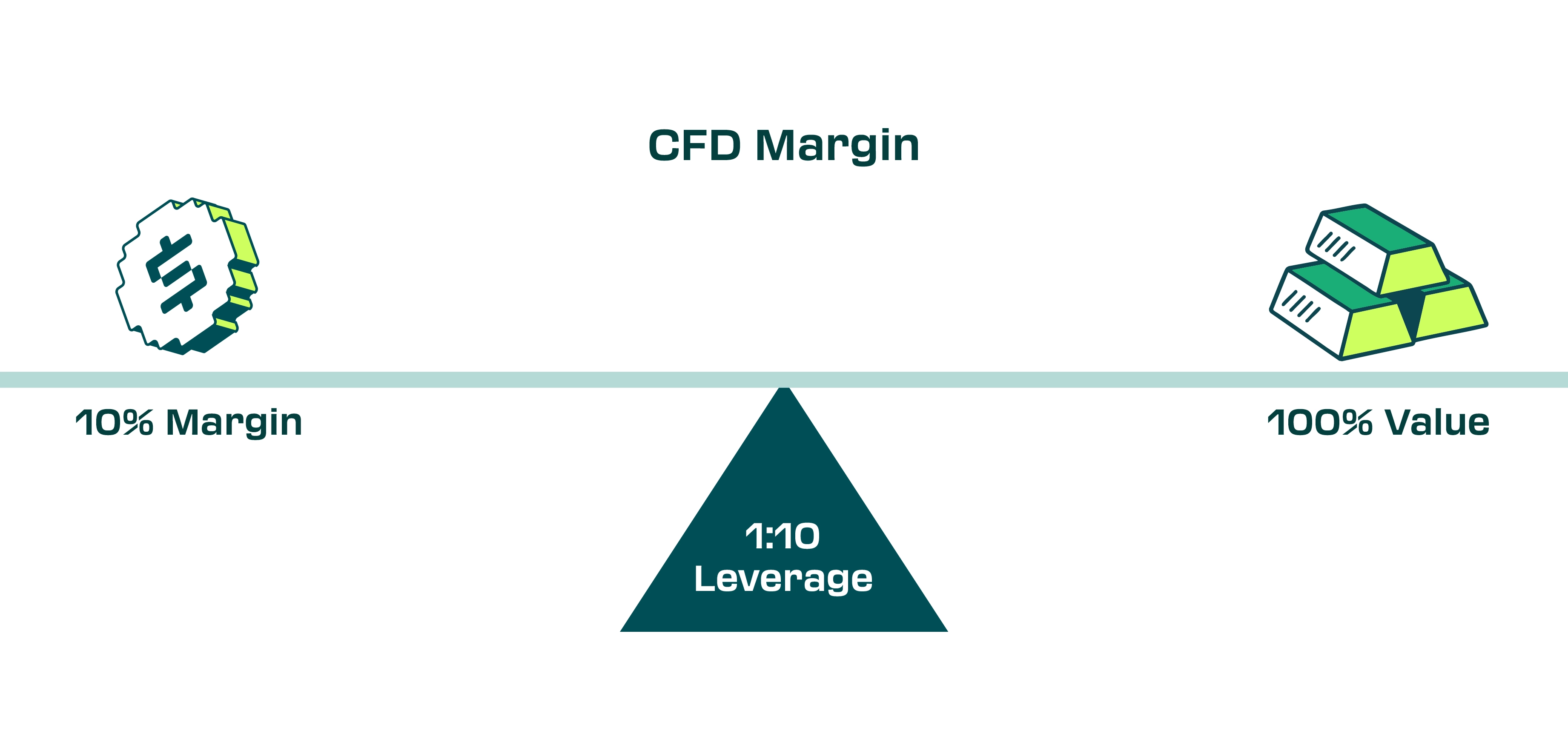
The appeal of leverage is that it can boost your potential profits dramatically. Because you’re controlling a larger position with borrowed funds, even a small favorable price move can result in a high return on the small amount of capital you put up. For example, suppose you have $1,000 and use 10:1 leverage to buy $10,000 worth of stock. If the stock’s price rises by 5%, your position gains $500. On your $1,000 margin, that’s a 50% return, whereas without leverage the same price move would have earned only $50 (a 5% return). This profit amplification is the main reason traders use leverage – it allows smaller accounts to achieve results that would normally require much more capital.
However, leverage is a double-edged sword. Just as it magnifies gains, it magnifies losses to the same degree. In the above example, if the stock drops 5% instead, your $10,000 position loses $500 – that’s a 50% loss on your $1,000 margin. With high leverage, even a relatively small adverse move can wipe out a large portion of your account. In fact, if the asset price falls 10% in a 10:1 leveraged position, you’d lose your entire $1,000 margin (100% loss) because $10,000 * 10% = $1,000. Small market fluctuations can have an outsized impact on a heavily leveraged account. This is why leveraged trading is often described as high-risk, high-reward. It’s critical to appreciate that while leverage can enhance profits, it exposes you to the possibility of larger, faster losses than trading without leverage.
To illustrate, consider two scenarios side by side:
- Trading without leverage: You invest $1,000 in an asset. A price drop of 10% means you lose $100 (10% of your capital).
- Trading with 10:1 leverage: You use $1,000 margin to control a $10,000 position. A price drop of 10% now results in a $1,000 loss – ten times larger, effectively losing 100% of your initial capital.
In the leveraged scenario, you’d have lost your entire deposit on that trade, whereas the unleveraged trader lost only a small portion of their account. This comparison shows how risk is amplified in leveraged trading. Of course, the reverse is true for gains – a 10% rise would double the leveraged trader’s capital, versus a modest 10% gain for the unleveraged trader. The key point is that leverage does not alter the market’s movement, but it hugely alters the scale of your P&L (profit and loss). Thus, leverage demands careful risk consideration.
Margin Requirements
When you trade on margin, you need to maintain a minimum amount of equity in your account as set by the broker. This is often broken into two levels:
- Initial Margin: The amount required to open a position. For example, if a CFD broker requires 5% margin on a stock index, and you want to buy $20,000 worth of that index, you must have $1,000 as margin to initiate the trade.
- Maintenance Margin: The minimum equity you must keep in the account to keep the position open.
Risks of Leveraged Trading (and How to Manage Them)
Leveraged trading carries several significant risks that every trader should understand:
- Amplified Losses: As discussed, leverage increases the size of losses relative to your investment. You can lose money much faster than in traditional investing. If markets move sharply against you, losses can exceed what you’d normally tolerate without leverage.
- Overnight and Financing Costs: Trading on margin isn’t free. If you hold positions overnight (or longer term), brokers typically charge interest or financing fees on the borrowed amount. These costs can add up and eat into your profits (or increase losses) over time. Margin trading is generally more suitable for shorter-term trades, partly because of these ongoing costs. Be aware of your broker’s policy: in CFD and spread betting accounts, the fee is often an overnight interest rate charge based on the position’s value.
- Emotional and Strategy Risks: High leverage can tempt traders into over-trading or taking on positions that are too large for their risk tolerance. The stress of big swings (since every move is magnified) can lead to emotional decision-making. Traders must have the discipline to stick to a risk management strategy and not be swayed by the lure of outsized gains or the fear of outsized losses.
Managing these risks is vital. Here are some key risk management practices for leveraged trading:
- Use Stop-Loss Orders: Always set a stop-loss to automatically cap your downside on each trade. This order triggers when it hits a predetermined price, so it ensures that if the market goes against you beyond a certain point, your position will be closed before losses run out of control. This is especially important with leverage, as your losses can increase fast.
- Limit Your Leverage: Just because high leverage is available doesn’t mean you should use it all. Many experienced traders recommend using lower leverage ratios, especially when you’re new. For example, if the broker offers up to 30:1, you might choose to use 5:1 or 10:1 on most trades. Using less leverage means you’re effectively risking less of your trading capital per price movement.
- Never Risk Your Whole Account on One Trade: It’s wise to use only a fraction of your capital for the margin on any single position. This way, a single loss (or margin call) won’t wipe you out. A common guideline is to risk no more than a small percentage of your account ( 1-2%) on one trade – this principle still applies even when using leverage.
- Keep a Margin Buffer: Don’t use up 100% of your available margin. Leave some funds unused so that if the market moves against you, you have a buffer before hitting a margin call. For instance, you might decide to utilize at most 50% of your account as margin at any time, leaving the rest to cover volatility.
- Monitor Positions Actively: When trading with leverage, actively monitor your trades and account equity. If you see losses accumulating, consider scaling back (closing part of the position) before a margin call forces a closure. Regularly checking your account’s margin level helps you stay proactive.
- Educate Yourself and Start Small: Make sure you fully understand how the specific product works, be it CFDs or Futures.
- By respecting these risk management rules, you can harness the potential rewards of leverage while mitigating the downsides. Leverage isn’t inherently bad – it’s a tool used by millions of traders. Used wisely, it lets you allocate capital efficiently and diversify (since you don’t tie up the full value on one trade). But used recklessly, it can lead to rapid losses. Always weigh the risk side of the equation as much as the reward side when trading on margin.
FAQs
What is the difference between margin and leverage?
Margin is the amount of your own money that you need to deposit to open a leveraged trade (think of it as the collateral). Leverage is the factor by which your trading capital is multiplied – it determines how large a position you can control relative to your margin. In essence, margin is a portion of the trade’s value that you put up, whereas leverage is the ratio of the trade’s total value to that margin. For example, a 10:1 leverage means you can trade a position ten times larger than your margin. If you put down $500 margin with 10:1 leverage, you’d control a $5,000 position.
Why use leverage in trading?
Traders use leverage to increase their exposure and potentially amplify their profits. Leverage allows you to make a larger trade with a smaller amount of capital. This can be useful for taking advantage of more opportunities or for getting a bigger return on a strong conviction trade. For instance, instead of needing $10,000 to buy 100 shares of a $100 stock, with 5:1 leverage you might only need to put up $2,000 to get the same exposure. If the trade is successful, your return on investment is much higher than it would be without leverage. Leverage also enables traders with limited capital to participate in markets (like certain stock or forex markets) that would otherwise be out of reach. Important: The benefits of leverage only materialize if trades go in your favor – and you must manage the accompanying risk (see next question).
What are the risks of leveraged trading?
The primary risk is that losses are magnified just as much as profits. If a trade moves against you, a leveraged position can incur large losses very quickly.
How do I calculate the margin needed for a trade?
The margin requirement is typically given as a percentage of the trade’s value or as a leverage ratio. To calculate margin needed, you can use either approach:
- Using Margin %: If the broker requires, say, 5% margin on a product, and you want to take a $10,000 position, the required margin is 5% of $10,000 = $500. In other words, $500 will be set aside from your account to open that trade.
- Using Leverage Ratio: If leverage is quoted as 20:1, this is equivalent to 5% margin (because 1/20 = 0.05). You can divide the position size by the leverage ratio. For a $10,000 trade at 20:1, divide 10,000/20 = \$500 margin needed.
The trading platforms will calculate and display the required margin for you on the order ticket. It’s important to note that different assets have different margin requirements – often determined by their volatility. For example, major currency pairs might have lower margin requirements (higher leverage allowed) than more volatile stocks or commodities.
Do I have to pay interest or fees when trading on margin?
Yes. When you trade on margin, you’re effectively borrowing funds from your broker to control a larger position, and just like any loan, this comes with a cost. For short-term trades (opened and closed intraday), the cost is minimal, but if you hold a position overnight, brokers will charge a financing fee or overnight interest on the leveraged portion of the position. This is often based on an interbank interest rate plus a markup.
How can I manage risk when trading with leverage?
Managing risk is absolutely essential in leveraged trading. Here are some best practices:
- Set a Stop-Loss: Decide the maximum loss you’re willing to take on a trade and set a stop-loss order at that price level. This automatically closes your position if the market moves against you by that amount, preventing larger losses.
- Use Proper Position Sizing: Don’t max out your leverage on each trade. Use a fraction of your account for margin so that you have breathing room. A common guideline is to risk only a small percentage of your capital on any trade (e.g. 1-2%). This remains true even when using leverage – it just means you would take a smaller position relative to what your maximum leverage allows.
- Overleveraging is one of the quickest ways traders blow up their accounts.
- Keep an Eye on your Margin Level: Monitor the health of your account. Most platforms show a margin level or percentage – if it starts nearing the danger zone, take action by closing some positions. Educate and Plan: Ensure you understand the instruments you’re trading and have a plan for each trade.
Should I use the maximum leverage available to me?
Not unless you fully understand the consequences and have a very high risk tolerance. Maximum leverage offers maximum potential profit but also maximum potential loss. Using the highest leverage means that even tiny market movements can have a big impact on your account. For most traders, especially newcomers, it’s wiser to use a moderate amount of leverage. Professional or experienced traders might occasionally use higher leverage for very short-term trades or when they have a high conviction and a strict exit plan. But even they tend to do so carefully. If you use maximum leverage on all your trades, you are basically one or two bad trades away from wiping out your account. It’s generally better to start low and increase leverage only as you gain experience and confidence in managing the risks.
What types of trades or markets allow margin and leverage?
Margin trading and leverage is common in several markets including FX pairs and CFD Indices, Commodities, Metals, and Cryptocurrencies.What’s important is that regardless of the market, the principles of margin and leverage work the same: you deposit a percentage of the trade’s value and borrow the rest from the broker. Always check the specific leverage limits and margin requirements for the market you’re interested in.
Any final advice for someone new to margin trading?
Start slow and small. Leverage is powerful so traders need to treat it with respect. Make sure you fully understand margin requirements and your broker’s policies (like how they handle margin calls, whether they have negative balance protection, what the overnight fees are). Practice in a demo environment if possible. When you go live, use low leverage and always have a risk management plan (position sizing, stop-loss levels, etc.). Think of leveraged trading as a marathon, not a sprint: the goal is consistent success over time, not betting the farm on one big trade. By approaching margin trading cautiously and knowledgeably, you can harness its benefits while minimizing pitfalls. Happy (and safe) trading!