Futures contracts are inherently leveraged instruments. This means you can control a large position with a relatively small amount of capital. In effect, you only put up a deposit (the initial margin) to hold a position worth much more. This leverage may amplify potential profits, and also losses on any given move.
Initial vs. Maintenance Margin
Whenever you enter a futures trade, you must post initial margin – a deposit to open your position. This is typically only a few percent of the full contract value. For example, many futures exchanges set initial margins in the range of 3–12% of notional value. (Check the margin of your NovaBloom account on our website.) Once the trade is open, you must maintain a certain maintenance margin in your account.
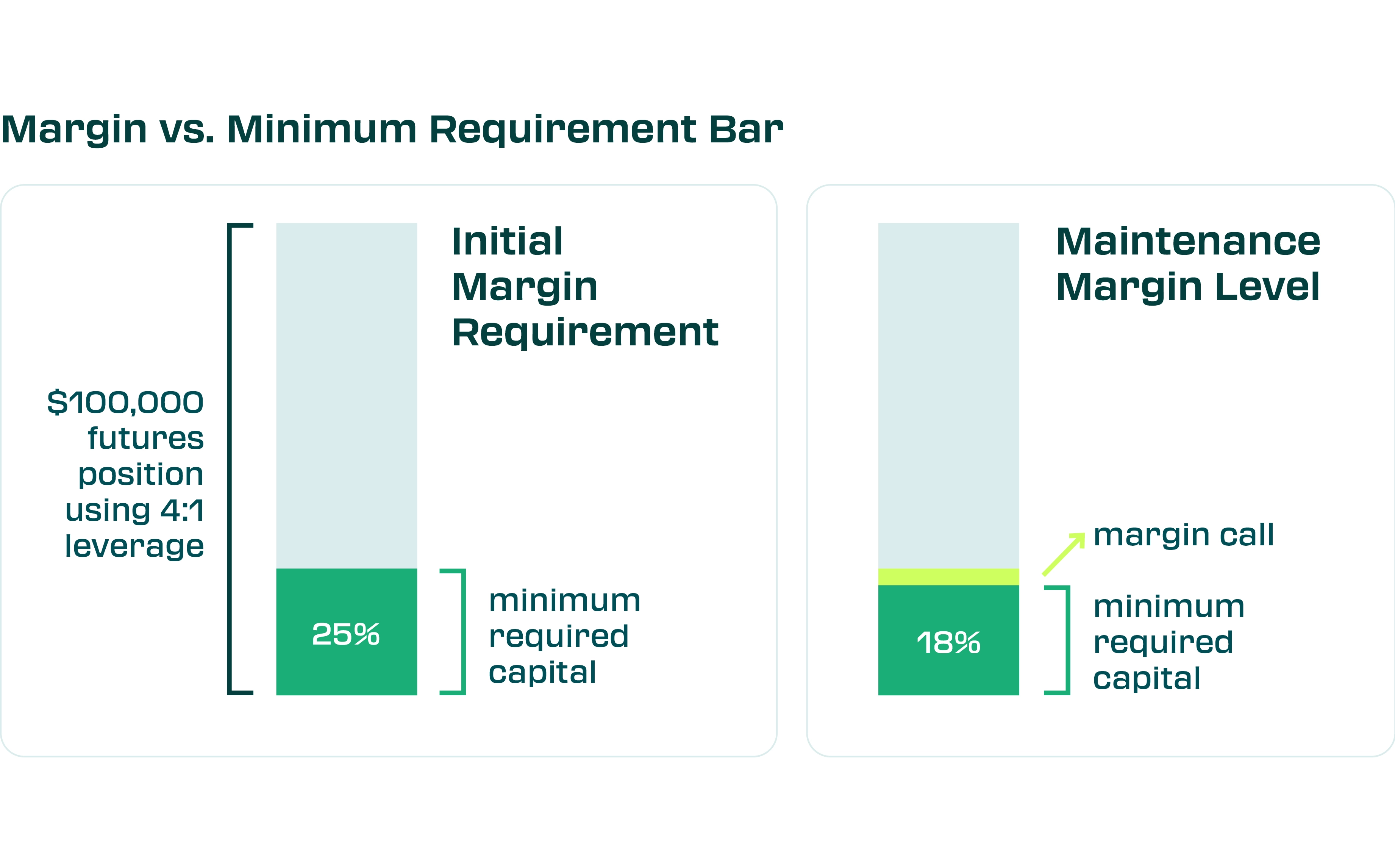
The maintenance margin is usually a bit lower than the initial margin (often around 80–90% of initial). In practice, brokers will often require around 110% of maintenance as the initial margin.
- Initial Margin: The minimum funds to open a futures position (in effect, a “good faith deposit”). It varies by contract and can change with market volatility.
- Maintenance Margin: A lower threshold you must keep as long as the position is open. If your account equity falls below this level, a margin call is triggered.
Since futures margin is not a loan but a deposit, you never “own” the contract outright – you owe only the P/L on the position, but your gains and losses are based on the full contract value. More volatile futures like cryptocurrency futures, for instance Micro Bitcoin, often need higher margin because of extreme volatility (sometimes 100% margin for retail).
Daily Settlement (Mark-to-Market) and Margin Calls
Futures are marked-to-market daily. Every trading day the exchange compares the contract’s settlement price to the previous price. If the market moves in your favor, your account is credited; if it moves against you, your account is debited. For example, if you are long one S&P contract and the index rises 10 points ($500), $500 is added to your account at day’s end. If it falls, $500 is withdrawn.
Because of daily settlement, if losses accumulate and your account equity drops below the maintenance margin, your broker will issue a margin call. A margin call simply means you must deposit more funds or close positions to prevent forced liquidation of trades.
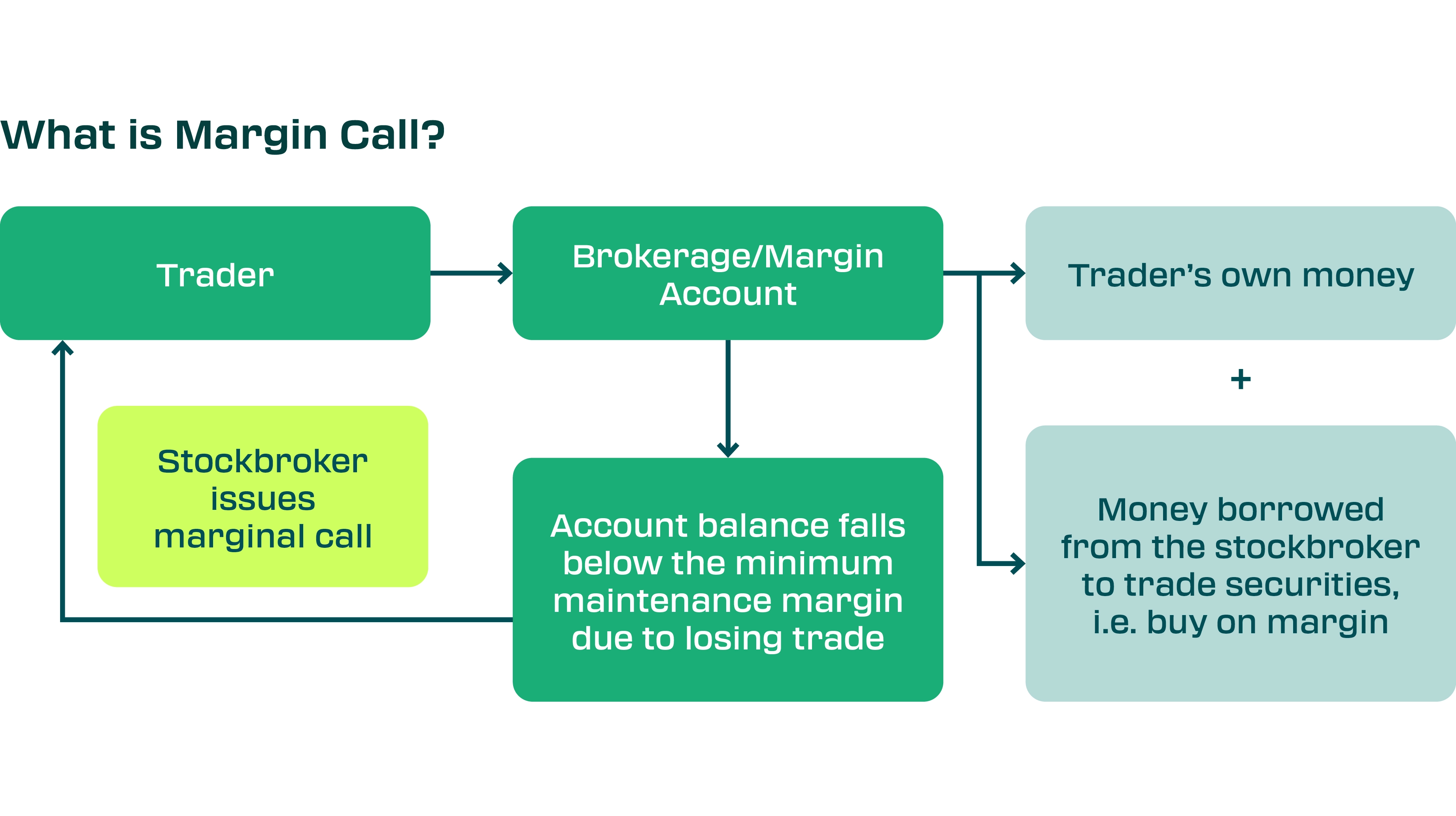
Specifically, you usually have to restore equity to the initial margin level If you cannot add funds, the broker may force you to reduce or sell positions.For example, imagine you bought two S&P 500 contracts with $4,800 initial margin each and a $4,500 maintenance margin each. If your combined losses exceed $1,000 (dropping below $9,000 total equity), you’d get a margin call to top up funds. The day settlement process is strict: any single day’s losses can immediately put you under the maintenance level, triggering a call or liquidation. It’s important to monitor your account daily and be prepared to add funds if needed (or scale back positions).
Managing Leverage and Risk
Because futures use leverage, risk management is critical. Here are some key strategies to keep risk in check:
- Know the contract’s risk profile: Different futures have different tick values and typical moves. For instance, an S&P 500 E-mini point is worth $50, so a 10-point swing is $500, a $1crude oil futures move is worth $1,000 and a $1 gold move is worth $100. Recognizing these values helps you understand how much a given price move will make or cost you, relative to your equity. Choose contracts whose potential swings fit your account size. Smaller accounts often use Micro or E-mini contracts to reduce dollar volatility.
- Limit your position size: Only trade as many contracts as your capital can realistically support and based on various risk scenarios. Do not max out just because you can meet the initial margin. In practice, set a rule (for example, never risk more than 2% of account on one trade) and size your futures accordingly.
- Use stop orders: Decide in advance how much you are willing to lose on a trade and use stop-loss orders to exit if the market moves against you. Stops “provide protection if the market does not move in your desired direction” and help prevent losses larger than you can handle. For example, if a single S&P contract’s 10-point loss ($500) would be too big a hit, place a stop to limit the loss.
- Keep buffer capital: Because margin requirements can change with volatility, always maintain extra margin. Many brokers monitor margin in real time and will warn or even liquidate positions if your account slips too far below maintenance. Never leave your account balance just at the maintenance level; keep spare equity for sudden moves.
- Diversify contracts: Avoid putting all your margin on one market. You might trade a mix of S&P futures, currency futures, and commodity futures so that a big move in one (say a 5% oil spike) is potentially partly offset by other positions.
By combining these steps, you calculate your exposure. For each futures position, you can calculate the notional value (e.g. index level × contract multiplier) and the dollar value per tick. This tells you exactly how much a move will gain or cost you. For example, if Micro Bitcoin futures have a $1 tick worth $1 per contract, then a $100 move costs $100 per contract. Use this to check your total risk: if you hold 10 Micro Bitcoin contracts, a $100 move is a $1,000 move in your account. Always ensure your account could absorb such swings without falling below maintenance.
Monitoring Exposure
Daily monitoring of your margin and exposure is essential. Each evening your broker will usually show your used margin and free equity. Watch these numbers after the market closes. If they get too close, consider closing or reducing positions rather than risking a margin call. Remember, futures typically stop trading on Friday afternoon (except crypto futures which trade around the clock), so an overnight or weekend gap can also affect your margin needs. Because futures margins adjust with market volatility, check for any margin increases on days with major news or big market moves.
In summary, leverage lets you take on a lot of market exposure with little money upfront, but it also means even small price changes can trigger big gains or losses. You pay initial margin to open a trade and must keep at least the maintenance margin in your account. Daily mark-to-market settles your profits and losses, and if your equity falls below maintenance, you’ll need to top up or your positions may be closed. Always plan for risk: know each contract’s tick value, use stops, trade position sizes you can afford, and keep an eye on your margin. By understanding margin, leverage, and risk, you can trade futures with clearer expectations of potential outcome.
FAQs
What is the difference between initial margin and maintenance margin?
Initial margin is the deposit you must post to open a futures position. Maintenance margin is the minimum equity you must keep after the trade is open. If your account falls below maintenance, you will get a margin call to restore funds back to the initial level.
How does leverage work in futures trading?
Leverage means you only put up a fraction of a contract’s total value. For example, one crude oil futures (worth ~$80,000) might require only ~$5,000 margin. That means you control $80,000 of oil with $5,000. If oil moves 1%, your gain or loss will be based on the full $80,000, not just your $5,000 – magnifying profits and losses.
What is mark-to-market?
Mark-to-market is the daily settlement process for futures. Each day’s price change is added to or subtracted from your account. Gains are credited, losses debited. This ensures that profits and losses are realized every day, not just at the end.
When will I receive a margin call?
You’ll receive a margin call when your account’s equity falls below the maintenance margin level. For example, if you needed $4,500 maintenance per contract but your account equity drops under that, the broker will ask you to top up funds.
What happens if I can’t meet a margin call?
If you don’t meet a margin call by depositing more funds or reducing positions, the broker can liquidate your positions to bring the account back into compliance. This can happen automatically if the losses continue.
Do margin requirements change?
Yes. Exchanges and brokers can raise or lower margin requirements based on volatility. During turbulent markets, you may see higher margin demands. Always check margin levels before entering new trades.
How much margin do I need to trade futures?
It depends on the contract and current conditions. As an example, a single S&P 500 E-mini contract might need around $5,000, whereas a Micro E-mini S&P might need around $1,000. Check the exchange or your broker for current numbers, and remember they can change daily.
Does trading futures on leverage increase my risk?
Absolutely. Leverage amplifies both gains and losses. That’s why risk management (position sizing, stops, monitoring margin) is so important. Even though you only put up a small margin, you’re on the hook for the full exposure of the contract.
How is risk calculated for a futures trade?
Risk is often calculated by considering how much a contract will move per tick. For instance, if one point in an index future equals $50, a 20-point potential move is $1,000 risk per contract. Multiply that by the number of contracts. Also consider worst-case scenarios (like gap moves).
Can futures positions earn or pay interest on margin?
Generally, you do not earn interest on margin posted for futures (the funds are held by the broker/exchange). It’s treated as a deposit or collateral. The main cost is the opportunity cost of having those funds tied up.
Are margin rules different for different asset types?
Yes. Equity index futures (like S&P 500), currency futures (like EUR/USD), commodity futures (crude oil, gold, corn), and crypto futures all have their own margin requirements set by their exchanges. Crypto futures often require higher margin due to volatility. Always check margin for the specific contract you plan to trade.
How do I monitor my futures exposure?
Use your trading platform’s margin report or statement. It will show used margin and free equity in real time. Keep an eye on these numbers each day. Calculate your total exposure by summing the notional value of all open contracts. If you’re getting close to limits, consider hedging or reducing positions.