Contracts for difference (CFDs) let you trade on price movements without owning any asset. Now that you know what a CFD is, let’s look at how CFD trading actually works in practice. In this follow-up, we’ll walk through opening and closing trades step-by-step, explain how profits and losses are calculated, peek at what happens behind the scenes when you place a trade, and see why CFDs are so popular for fast-paced, short-term trading. Throughout, we’ll keep things clear and jargon-free (explaining any terms as needed), with short paragraphs, useful subheadings, and simple examples to illustrate key points.
Opening and Closing a CFD Trade: Step by Step
Trading a CFD involves a few straightforward steps from start to finish. Below is a point-by-point guide to opening a CFD position and closing it out:
- Choose Your Market and Direction (Buy or Sell) – First, you select which market or asset you want to trade. CFDs are available on many markets – for example, indices, currency pairs, commodities, and cryptocurrencies.
Next, decide the direction of your trade. If you expect the price to rise, you buy CFDs (go “long”). If you expect the price to fall, you sell CFDs (go “short”). One big appeal of CFDs is this flexibility – you can speculate on both rising and falling markets with equal ease. Going long means you profit when the price goes up; going short means you profit when the price goes down (and lose money if it goes up instead).
- Decide Your Trade Size and Check Margin Requirements – Choose how many CFD contracts or units to trade. The size of your position will determine the profit or loss from price movements. Unlike buying assets outright, with CFDs you only need to put up a fraction of the trade’s value as a margin deposit (the rest is effectively lent to you by the broker via leverage).
For example, if the margin requirement is 20%, a trade equivalent to $10,000 of stock would require only $2,000 in margin. This leverage is powerful – it lets you control a larger position with a smaller amount of capital. Always be mindful that while leverage can amplify profits, it also amplifies losses on that full $10,000 exposure, not just your $2,000 margin.
- Place the Trade (Open the Position) – Using your CFD trading platform, you then execute the order. This could be a market order (to buy/sell immediately at the current price) or a pending order (like a limit order) at a specific price. If you’re going long (buying), you will buy at the broker’s ask price; if going short (selling), you sell at the bid price. The difference between these prices is called the spread, which is essentially a small built-in cost of the trade. Once your order is placed and filled, your CFD position is open.
At this moment, no exchange of a physical asset occurs – for example, you haven’t bought actual shares or barrels of oil. Instead, you’ve entered a contract with the broker to exchange the price difference from here on. Your profit or loss now starts to fluctuate with the underlying market price. (On most trading platforms you can watch your open trade in real time and see its current profit/loss displayed.)
- (Optional) Set Stop-Loss and Take-Profit Levels – It’s wise to set up risk management orders once your trade is open. Two common examples are;
A stop-loss which is an instruction to automatically close your trade if the market moves against you by a certain amount, limiting your loss.
A take-profit does the opposite – it closes your trade when a certain profit target is reached.
Since your trade’s final profit or loss is only realized when you close it, these preset orders effectively close the position for you at predefined levels. For example, you might set a stop-loss to sell your CFD if the price falls too far, or a take-profit to lock in gains if the price hits a favorable level. Setting these levels in advance helps manage your risk.
- Monitor the Trade – With your position open, you’ll want to keep an eye on the market. The CFD’s price will move in tandem with the underlying asset’s price (often nearly tick for tick). Your unrealized P&L (profit or loss) will update accordingly. If the market moves in your favor (up for a long position, or down for a short), you’ll see an unrealized profit. If it moves against you, you’ll see an unrealized loss. At this stage, nothing is final – the P&L is “floating” and will change until you close the trade. You can adjust or tighten your stop-loss and take-profit orders as the trade progresses, or even add to your position if desired.
A key point to remember is that CFD trading often happens on fast electronic platforms that allow instant access to global markets. When you click “Buy” or “Sell,” your order is typically executed within milliseconds through your broker’s systems and liquidity providers. This speedy execution is crucial in a fast-paced market where prices can change quickly.
- Close the Position (Exit the Trade) – To close your CFD trade and realize your profit or loss, you execute the opposite transaction to your opening trade. If you originally bought CFDs to open, you’ll now sell the same number of contracts to close (and vice versa for a short position). Most trading platforms have a “Close” button to do this in one click. When you close, the difference between the opening price and closing price of your CFD position is calculated. The broker will credit your account with profits or deduct losses accordingly.
In other words, if the market moves in your favor, you receive the price difference as profit; if it moves against you, you pay the difference, which comes out of your account balance. Only once the position is closed is your P&L finalized. At this point, any margin that was tied up for the trade is released back to your account, and the trade is complete.
How Profit and Loss are Calculated
Calculating your profit or loss on a CFD trade is straightforward. As noted above, it all comes down to the price movement of the underlying asset and the size of your position. The basic formula is:
Profit or Loss=ClosingPrice–OpeningPriceNumber of CFD Units
For a long (buy) position, profit happens if the closing price is higher than the opening price (positive difference), and loss if the closing price is lower (negative difference).
For a short (sell) position, it’s the reverse – you profit if the closing price is lower than your opening price (because you sold high and bought back lower), and you lose money if the price rises.
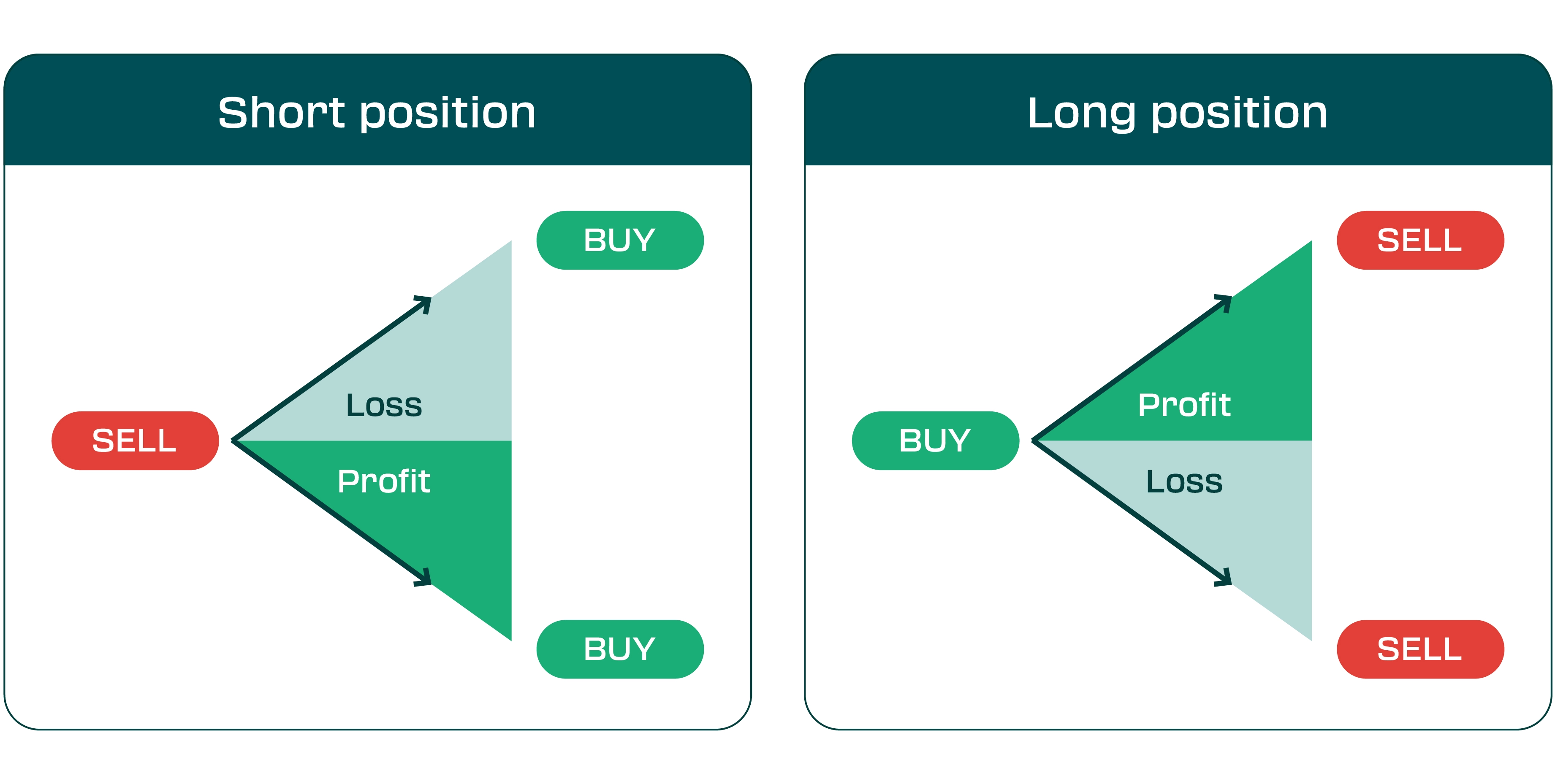
The diagram above illustrates profit and loss for CFD positions. A long position (right) is opened by buying and closed by selling them – it earns a profit if the price goes up and incurs a loss if the price goes down. A short position (left) is opened by selling CFDs and closed by buying them back – it profits when the price falls and loses if the price rises.
In both cases, the formula is the same; what changes is whether you were long or short. Notice that profit/loss is proportional to position size – a larger position means each price movement has a bigger impact on your P&L. This is why managing position size and leverage is important.
Don’t forget trading costs: Your gross profit or loss from price movement may be adjusted by any applicable costs. These include:
- Spread: This is the gap between the buy and sell price. When you open a trade, you pay the spread as the immediate cost (you buy slightly above market or sell slightly below). This means the market has to move enough in your favor to cover the spread before your position shows a profit. *
- Commissions: Some CFD brokers charge a small commission per trade (often for stock CFDs).
In summary, your net profit = price difference × position size minus any costs. For example, if your gross profit from price movement is $200 but you paid a $3.50 commission, your net profit would be $196.50. It’s important to account for these costs when planning a trade, especially for short-term trades where tight profit targets can be eaten up by fees.
What Happens Behind the Scenes When You Place a Trade
When you click “Buy” or “Sell” on a CFD platform, a lot happens behind the scenes to make that trade possible. Understanding this process can give you a clearer picture of what a CFD trade really is:
- Your broker is the counterparty: A CFD is an agreement between you and the broker (or CFD provider). Unlike trading stocks on an exchange where you buy shares from another investor, with a CFD you’re dealing directly with the broker. You do not take ownership of any underlying asset; no shares or commodities change hands. Instead, the broker mirrors the asset’s price for you. Essentially, the broker agrees to pay you the difference if the asset’s price goes up (and you’re long), or you agree to pay them the difference if it goes down – and vice versa for short positions. This is why it’s called a contract for difference – it’s all about the price difference from open to close.
- Trade execution and pricing: Even though the CFD trade is with your broker, the price of the CFD is based on the real market price of the underlying asset. Good brokers ensure their CFD prices track the live market closely. When you place an order, the broker’s trading platform will either match your order with a corresponding order in the real market or with other clients’ orders, or they might take the other side of your trade themselves (depending on their trading model). Modern CFD brokers often have connections to large liquidity providers (banks, market makers) and use advanced systems to execute your trade at the best available price in milliseconds. For you as the trader, this generally means you click buy/sell and your order is filled almost instantly at a price very close to the current market price. The broker’s systems handle all the routing and settlement behind the curtain.
- Leverage and margin mechanics: Behind the scenes, your broker is effectively loaning you the majority of the position’s value when you trade on margin. For example, if you open a $10,000 position with $2,000 margin, the broker is financing the remaining $8,000. Because of this, the broker will lock up your $2,000 margin as collateral in case the trade moves against you. They continually monitor the value of your position against your account equity. If the market moves in your favor, your account equity increases from the unrealized profit (and vice versa if it moves against you). If losses mount to a certain point, the broker will usually alert you with a margin call (a warning that you need to deposit more funds or close positions).
- No ownership, no rights: Since you don’t own the underlying asset when trading a CFD, you also don’t get shareholder rights like voting or dividends in the traditional sense. If a stock pays a dividend, your broker might adjust your CFD position (typically crediting long positions with an equivalent amount, and debiting short positions) so that you aren’t disadvantaged or advantaged by the dividend. But you’re not actually receiving a dividend as a shareholder. Similarly, you won’t have to deal with things like taking delivery of commodities or exchanging currencies – the CFD is purely a financial contract. This simplicity is one reason many traders appreciate CFDs: everything is handled through the platform without the practical hassles of asset ownership. For instance,there is no stamp duty paid on UK CFDtrades, no custody fees or settlement delays.
- Behind-the-scenes adjustments: Your broker takes care of various adjustments behind the scenes. For instance, if you hold an index CFD and one of the constituent stocks has a corporate action (like a stock split or special dividend), the broker will adjust the index price or your position accordingly. If you hold a CFD past the market’s daily close, the broker will calculate the overnight financing charge and deduct it (for long positions) or add it (for short positions) to your account,which usually happens once per day. These adjustments are typciallysmall and made automatically, but they are happening in the background each day.
In essence, what happens when you trade a CFD is that the broker provides you exposure to the market and manages all the operational complexity on their side. They ensure there’s liquidity for you to get in and out of trades, they track the underlying price and update your position value, they handle the leverage and margin, and they facilitate your profit/loss payment when you close your position. This comes at the cost of spreads/fees, but in return you get a very efficient trading experience.
A helpful way to think of it: CFD brokers are the middlemen connecting you to the markets. They operate sophisticated trading platforms and risk systems “behind the screens” so that your trades feel as simple as clicking buy or sell. This allows you to focus on market moves and strategy, while the broker takes care of execution and accounting in real time.
Why CFDs Are Suited to Fast-Paced, Short-Term Trading
CFDs have exploded in popularity among active traders, day traders, and those who like to catch short-term market moves. Here are the key reasons traders use CFDs, especially in fast-paced trading environments:
- Leverage = More Exposure with Less Capital: CFD trading is synonymous with leverage – you can control large positions with a relatively small amount of money. This is hugely attractive for short-term traders looking to capitalize on small price movements. With leverage, a 1% move in the market can translate to a much larger percentage gain (or loss) on your capital, which is ideal for strategies like day trading or scalping where you aim for quick, small profits repeatedly. Traditional investing would require a lot of capital to achieve the same returns on a 1% move. Important: Leverage is a double-edged sword; while it can boost short-term returns, it also makes trading riskier, so it must be used with caution.
- Ability to Go Long or Short Effortlessly: CFDs have no short-selling restrictions. In a traditional stock account, shorting (betting against a stock) can involve borrowing shares and other hurdles. With CFDs, going short is as simple as clicking sell – the broker handles the rest. This means traders can take advantage of opportunities in both rising and falling markets instantly. In a fast-paced environment, being able to flip directions quickly (e.g. reversing from long to short if a trend turns) is invaluable. You can even hedge easily – for example, open a short CFD on an index to hedge stock holdings temporarily. The ease of short selling with CFDs is a major reason they’re a preferred tool for active traders.
- Wide Range of Markets from One Platform: CFD brokers typically offer a very broad menu of markets through a single account. You can trade equity indices, forex pairs, commodities, cryptocurrencies, all from the same platform. This is ideal for short-term traders who might scan multiple markets for opportunities. For instance, you might trade forex in the morning, an index in the afternoon, and a commodity in the evening – all using CFDs. This variety means more chances to find volatility and trading setups at any time of day. It also lets you react to news or events in any market without needing different accounts or large capital outlays for each market.
- Quick Trade Execution and No Expiry: CFD trading platforms are built for speed and frequent trading. Orders get executed very quickly(often a fraction of a second), which is crucial for intraday trading. Also, most CFDs have no fixed expiry (unless you’re trading a forward/futures CFD, which some brokers offer, but the standard “spot” CFDs can be held indefinitely). This means you decide how long to keep the position open – minutes, hours, days – there’s no automatic expiry. Short-term traders usually close out by the end of day to avoid overnight fees, but it’s flexible. The lack of expiry contrasts with options or futures that expire on a set date. That means CFDs are well-suited for any time horizon on the short-to-medium term; you’re not forced out of a trade until you choose to be (or your margin runs out). Positions can be opened and closed within minutes, hours or days as needed, giving traders full control over trade duration.
- No Ownership Hassles, Just Pure Trading: CFDs strip the process down to pure price speculation. This “clean” and simplified trading experience appeals to short-term traders who want to focus on charts and strategy rather than operational details. There’s no need to manage physical assets, worry about delivery, or deal with corporate actions (the broker handles adjustments). If you’re trading in a fast-paced environment, this simplicity means fewer things to slow you down. You can quickly enter or exit trades with a couple of clicks. The administrative overhead of trading is minimal. Moreover, certain costs associated with owning assets are avoided – for example, no stamp duty on CFD trades in some jurisdictions like the UK (because you’re not changing ownership of shares). All of this makes CFDs a very streamlined vehicle for rapid trading.
All the above factors contribute to why CFDs are a favorite for short-term and high-frequency trading strategies. Day traders often gravitate to CFDs because they can deploy strategies with small capital, quickly enter/exit positions, and find ample opportunities across markets. Scalpers (who make very quick in-and-out trades for a few pips/points) benefit from the tight spreads and fast execution. Swing traders (holding for days) like the ability to go short or use moderate leverage to enhance returns on short-term swings. Basically, for active trading, CFDs provide a level of flexibility and efficiency that traditional trading (buying actual assets) can’t match easily.
However, it’s important to note that the very features that make CFDs great for short-term trading – leverage, ease of trading, quick market access – also carry risk. Losses can accumulate quickly if trades go wrong, especially with high leverage. And frequent trading can incur a lot of spread/commission costs. So while CFDs are suited to fast-paced trading, success still requires discipline and good risk management (topics you’ll encounter as you continue in this education series).
By understanding these aspects of CFD trading – the process of opening/closing trades, the P&L calculation, what’s happening behind the scenes, and the reasons traders embrace CFDs for short-term trading – you’ll be better prepared to use these instruments wisely. CFDs offer an accessible and flexible way to trade numerous markets, but always remember that with great power (leverage) comes great responsibility (risk management). In the next article, we’ll dive deeper into margin, leverage, and risk management, which will further expand on how to use CFDs safely and effectively. Happy trading!
FAQs
Do you own the asset when trading a CFD?
No – when you trade a CFD, you never own the underlying asset. The CFD is a contract with your broker where you exchange the price difference from when you open the trade to when you close it. It’s purely a way to speculate on price movements. For example, if you trade a gold CFD, you’re not buying any physical gold; you’re just betting on its price change. This is why CFD trading is simpler in terms of logistics (no storage of commodities, no share certificates), but you also forgo any ownership benefits like dividends or voting rights on stocks.
How do you make money from CFDs?
You make money on a CFD trade by correctly predicting the asset’s price movement and closing the trade with a favorable price difference. If you buy a CFD (go long) and the underlying price goes up, you can sell it at the higher price to profit on the difference. If you sell a CFD (go short) and the price goes down, you can buy it back cheaper and pocket the difference. Essentially, the broker will pay you the difference if the market moves in your favor, or you’ll pay the difference if it moves against you The formula is: profit (or loss) = price change × your position size. For instance, if you bought a CFD at $100 and sold at $110 with 10 units, the $10 increase × 10 units = $100 profit. Keep in mind any trading fees will be subtracted from this.
What markets can I trade CFDs on?
A huge variety – one of the advantages of CFDs is access to many markets from one account. See the products page on our site for the current list of tradable products.
How do I close a CFD trade?
To close a CFD trade, you perform the opposite action of what you did to open it. If you opened by buying CFDs, you close by selling the same number of CFDs. If you opened by selling (shorting), you close by buying the same number back. Most brokers make this easy – your trading platform will typically have a “Close” button or you can place an order to close at market price. Once closed, your profit or loss is realized and will reflect in your account balance (it’s calculated as the difference between the opening and closing prices times your position size, minus any fees). For example, if you bought 5 CFDs at $20 and later closed (sold) at $22, the trade is closed and you secure that $2 × 5 = $10 profit (minus costs). Until you close, any gains or losses are just on paper.
Can I close a CFD position at any time?
Yes, generally you can close a CFD trade whenever you want, as long as the market for that asset is open. CFDs don’t have a set expiry (in most cases), so you’re free to exit the trade manually whenever you feel the time is right – it could be seconds after opening or days later. That said, markets have trading hours. For example, you can only trade a UK stock CFD when the London stock market or an after-hours market is open. Many major markets (forex, indices) are open nearly 24 hours on weekdays, so in practical terms you usually have flexibility to close trades even in the evening. The key point: you’re not locked in – you can react to the market and close a trade at your discretion. In fact, the short-term nature of CFD trading means you’ll often be closing trades the same day or within a few days. Just be mindful of any overnight fees if you choose to hold a position for multiple days.
What happens if I hold a CFD trade over the weekend?
Holding a CFD over a weekend will incur a weekend financing charge (also called a swap or rollover fee). Hold Over Weekend is a Point-of-Sale add-on that disables the “Flat for Weekend” requirement; this allows traders to keep positions open over the weekend. Only crypto can be traded over the weekend.
What fees do I pay when trading CFDs?
The main fees in CFD trading are:
- Spread: This is the built-in cost on every trade – the difference between the buy (ask) and sell (bid) price. You “pay” the spread at entry (and exit) because if you buy and immediately sell, you’d lose the spread amount. Brokers often widen the spread slightly to earn from trades. A tighter spread is better for you as a trader.
- Commission: This varies from product to product, check on the platform the product you plan to trade.
In summary, for each trade you’re typically looking at paying the spread and maybe a commission, and then paying a financing or overnight fee each day you keep it open. The good news is there are no hidden fees as everything is usually outlined by the broker. Note that the overnight fee can accumulate, especially for longer-term CFD positions. If you keep your trades short-term (intraday), you’ll mostly just be dealing with the spread and any commission.
How much money do I need to start trading CFDs?
Our trading accounts start from $42.
Are CFDs good for day trading and short-term trades?
Yes, CFDs are very popular for day trading and other short-term strategies. In fact, they are designed with active trading in mind. With CFDs you get quick access to markets and can open/close trades within the same day (or even within minutes) easily. The leverage allows day traders to amplify small intraday price movements for potential profit. Additionally, the ability to go long or short means you can trade opportunistically based on short-term trends or news – you’re not restricted to only profiting in rising markets. The cost structure (spreads and overnight fees) also incentivizes short-term use; you avoid overnight fees if you close by the end of day. Many retail traders are indeed day traders who gravitate towards CFDs “because of these instruments’ available leverage and simple architecture”. That said, short-term trading with CFDs still requires skill – the leverage and fast markets can lead to quick losses if you’re not careful. But in terms of trading vehicles, CFDs are arguably one of the best-suited for day trading, scalping, and swing trading due to their flexibility and efficiency.